.

A
Palestinian man carries an injured child following the Israeli military
strike on the UN shelter in Rafah. At least 10 people were killed in
the strike, the seventh on a UN-run shelter in Gaza: photo by ??? Said Khatib / AFP, 3 August 2014 via The Independent, 3 August 2014
It was, for the 27th day of a war, a very normal scene. Outside
the Anas Ibn Malik boys preparatory school in the centre of the southern Gaza
city of Rafah, a group of children bought sweets and biscuits from
local hawkers. Adults discussed "the situation". The school caretaker
stood talking to a friend.
Then, some time between 10.30 and
10.50, something struck the metalled road directly opposite the open
gates and exploded, hurling shards of red-hot shrapnel and concrete.
Fatih Firdbari, 30, was leaning against a friend's battered tuk-tuk, a small truck.
"There
was a big bang. I felt nothing at first and then I fell down. I looked
around and saw people lying on the ground. I saw I was wounded in the
calf," said Firdbari, a farmer who had fled his land close to the nearby
border crossing with Egypt in the early days of the latest war between
Hamas and Israel.

Palestinians gathered around victims of an airstrike Sunday at a school in Rafah: photo by Ibraheem Abu Mustafa / Reuters, 3 August 2014
There
was a moment's stunned silence, and then screaming, witnesses said.
Just inside the school, where more than 3,000 people have been
sheltering under the protection of UN flags during intense bombardment
and clashes in recent days, 20-year-old Mohammed Bahabsa writhed on the
ground, hit in the back and arm. Though wounded himself, the father of
seven-year-old Sabir Kershif picked up his unconscious son, who was
bleeding from a head wound.

A Palestinian carries a wounded boy following an Israeli air strike at a United Nations-run school: photo by ( /Ibraheem Abu Mustafa / Reuters, 3 August 2014
Mohammed Abu Adwan, 15, had been sitting on a bench with his friend Moaz Abu Ras.
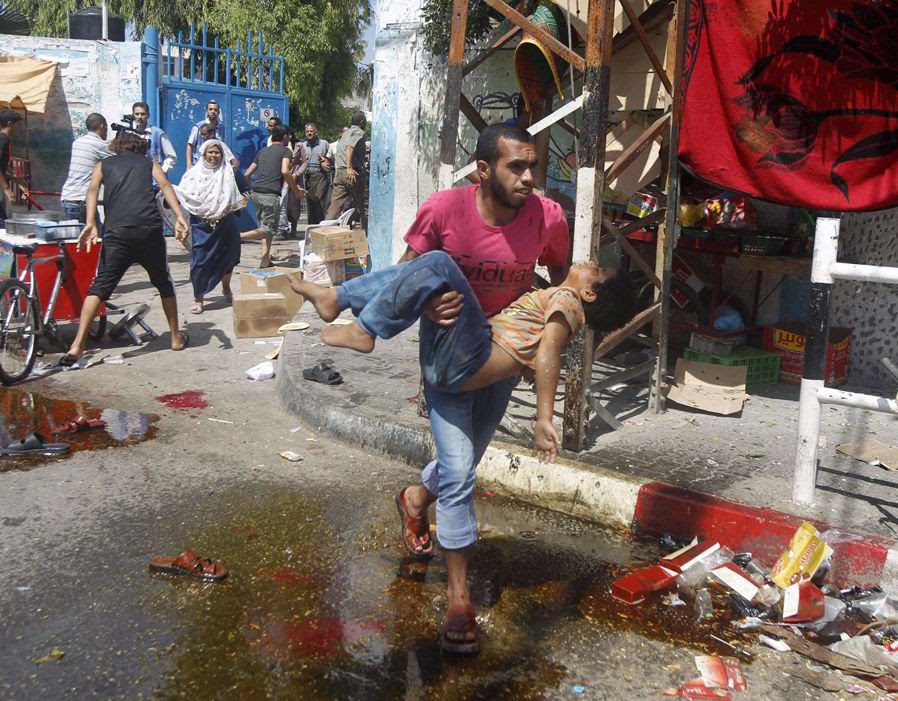
A Palestinian man carries an injured child following an Israeli military strike on a UN school in Rafah, in the southern Gaza Strip on August 3, 2014. At least 10 people were killed in a fresh strike on a UN school in southern Gaza which was sheltering Palestinians displaced by an Israeli military offensive, medics said: photo by AFP, 3 August 2014
"Suddenly there was an explosion. It came from nowhere," he said.

A Palestinians carry a wounded man following an Israeli air strike at a United Nations-run school, where displaced Palestinians take refuge, in Rafah in the southern Gaza Strip: photo by Ibraheem Abu Mustafa / Reuters, 3 August 2014

A Palestinian man carries a child killed in a blast outside a UN run school in Rafah, in the southern Gaza Strip, Sunday, Aug. 3, 2014. UNRWA's Director of Operations in the Gaza Strip said preliminary findings indicated the blast was a result of an Israeli airstrike near the school that been providing shelter for some 3,000 people: photo by Hatem Ali / AP, 3 August 2014

Palestinians carry an injured man following an Israeli military strike on a U.N. school in Rafah on August 3: photo by Said Khatib / AFP, 3 August 2014
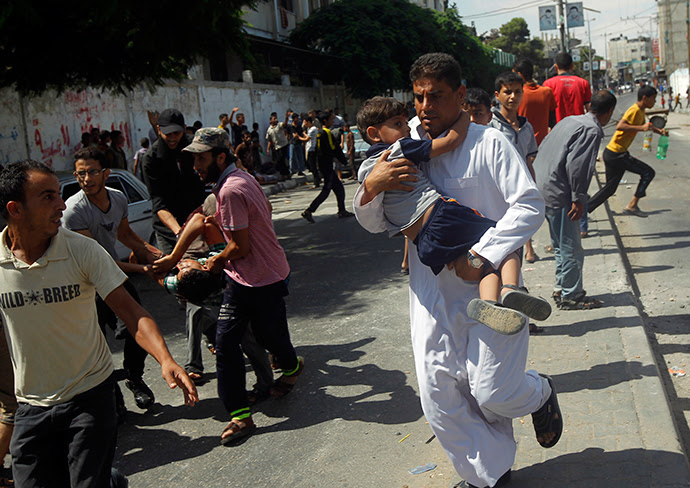
Palestinians carry injured people following an Israeli military strike on a UN school in Rafah, in the southern Gaza Strip on August 3, 2014: photo by Said Khatib / AFP, 3 August 2014
![Palestinians carry injured people following an Israeli military strike on a UN school in Rafah, in the southern Gaza Strip on August 3, 2014. At least 10 people were killed in a fresh strike on a UN school in southern Gaza which was sheltering Palestinians displaced by an Israeli military offensive, medics said. [AP]](https://blogger.googleusercontent.com/img/proxy/AVvXsEhnbFpn91dVsuxASAO05BEszsaXFqmT8tcJGKPlhyphenhyphenS5K90F5vpKTkUgBAEL5eePhQkJwxNPZEaD_8XAgGPInstDcBpfYt0ZejgmyaygKuB6ALy_S4zYViRVGUeF0UxQaBcq64WduACV09hILMPhQmfuGIJOF2hrYu3wnxseBPMotSqno7I=s0-d-e1-ft)
Palestinians
carry injured people following an Israeli military strike on a UN
school in Rafah, in the southern Gaza Strip on August 3, 2014: photo by Said Khatib / AFP, 3 August 2014
An
hour later, the extent of the carnage became clear. As casualties from a
second incident elsewhere in Rafah arriving at the tiny 20-bed Kuwaiti
clinic to be treated in a makeshift emergency ward set up in its
carpark, relatives began coming to collect their dead. Ten people had
been killed and at least 30 injured.
They included Ahmed Abu Harba, 13, and Yusef Iskaafia, 10, who lived near the school and had been selling biscuits there.
Iskaafia
was carried into his home by midday, borne by relatives down the
deserted street, wrapped in a white shroud, his pale, unscarred face
visible between folds in the white, blood-flecked cloth. He would be
buried within hours.
"He was just a normal kid, from a good family. He had no idea what was going on," a neighbour said.
Quite
where the projectile had come from is impossible to say without
detailed ballistic analysis. The hole it left, between eight and ten
metres from the school gates, was very narrow and very deep.
The
air strike was the third time in 10 days that a UN school had been hit
and came four days after Israeli tank shells hit a school in the
northern Gaza town of Jabaliya, killing 16 people. Seven UN facilities
have been struck during the conflict.
An
Israeli military spokesman said the incident was under review, but "we
were targeting terrorists on a motorbike near the school and did
identify a successful hit on a motorbike".
Fifteen-year-old Mohammed Abu Adwan, who had been
buying sweets with his friend Moath when the blast occurred, was curled
in a semi-foetal position on a plastic chair in a corridor, half naked
and wrapped in a soiled hospital blanket. Moath was dead, he said
quietly, though his friend's name is yet to feature on any casualty
lists.
On the floor a classroom in the school, the mother of
seven-year-old Saqir Kershif, whom she had last seen bleeding heavily in
the arms of his injured father, sobbed steadily. Her uncle had
telephoned her to say he could not find either her son or her husband at
the city's clinics.
"Where can we go if they cannot protect us?
Why did they tell us the UN school would be safe? We could have stayed
and died at home," said Hasna, 22.
Rafah
residents count human cost of Israeli offensive: Southern Gaza city has
been hit by some of the heaviest bombing, culminated in a deadly air
strike on an UNWRA school
Jason Burke in Rafah, The Guardian, Sunday 3 August 2014

Aftermath of an Israeli air strike at a United Nations-run school in Rafah: photo by Ibraheem Abu Mustafa / Reuters, 3 August 2014


